Welcome to
ZnOrgBAT –
Pioneering the Future of Sustainable Energy Storage
ZnOrgBAT responds to the urgent global demand for rechargeable, sustainable, safe, and cost-effective stationary energy storage solutions. As the world accelerates its shift towards a carbon-neutral economy, our project is developing next-generation Zinc-Organic batteries. Our vision aligns with the broader goal of delivering affordable, clean, and reliable energy for all.


The Challenge
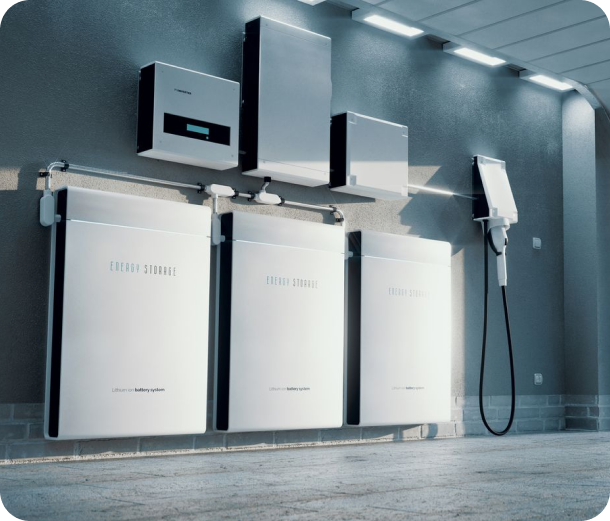
The transition to a carbon-neutral economy demands energy storage systems that are not only efficient and long-lasting, but also safe, affordable, and sustainable. As the adoption of renewable energy grows, so does the need for stationary storage solutions that can balance supply and demand at grid and local levels.
Today, many stationary systems rely on lithium-ion batteries (LIBs) originally developed for electric mobility. While LIBs offer high energy density, they are not optimized for stationary use, where cost-effectiveness, safety, lifespan, and sustainability are often more critical than compact size or weight.
Moreover, lithium and other key LIB materials are classified as Critical Raw Materials (CRMs), making these technologies vulnerable to supply disruptions, geopolitical tensions, and environmental concerns related to extraction and processing.
There is a growing need for battery technologies designed specifically for stationary storage, using abundant, non-critical, and environmentally benign materials
Our solution
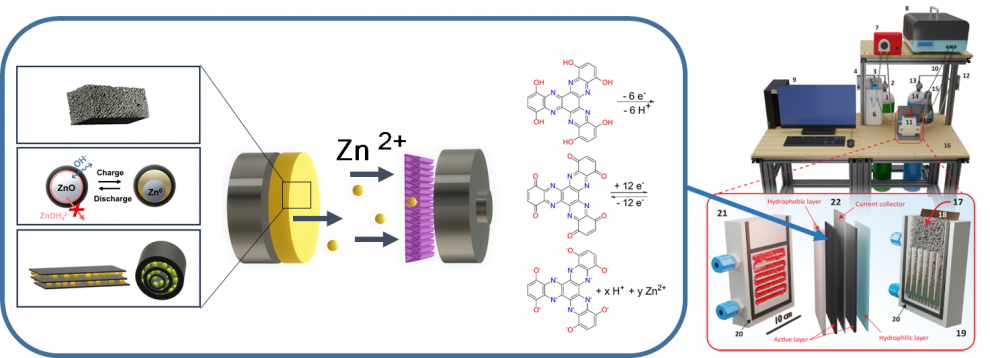
ZnOrgBAT proposes a new class of rechargeable stationary batteries built with zinc anode and organic cathode. While not aiming to compete with LIBs on energy density, this system offers a compelling alternative based on safety, sustainability, and cost.
Key advantages of ZnOrgBAT technology include:
Use of widespread/earth-abundant and non-toxic materials, free from CRMs and fluorinated compounds.
Inherent safety, with aqueous electrolytes and non-flammable components.
Long cycle life, designed to meet the performance needs of long-duration stationary applications.
Competitive cost, with the potential to undercut the price of commercial LIBs for stationary use.
Within the project, a prototype system will be developed and tested under relevant conditions. Alongside technical development, ZnOrgBAT will support the creation of a dedicated start-up to drive commercialization and strengthen Europe position in the energy storage value chain.

Project coordinator


Slovenian National Building and Civil Engineering Institute
ZAG in the role of the project coordinator is a public research institute in the field of built environment and has extensive experience in implementing circular economy models. The Department of Materials at ZAG has a strong expertise in microstructural characterization of a large variety of materials combining advanced 3D and 4D X-ray and neutron imaging techniques with more conventional 2D imaging and spectroscopic methods. This research activity is of paramount importance for the ZnOrgBAT project development. ZAG has established a strong collaboration with industry (business-to-business) and conducted national and international projects. The ZAG role in the project covers: project management, support to communication and dissemination activities as well as providing expertise in microstructural analyses through non-destructive testing, and implementing capacity-building activities.
Project partners

Media Lario
Established in 1993, Media Lario is a forward-thinking technology enterprise specializing in advanced optical components and systems tailored to diverse markets. Through the utilization of a patented electrodeposition manufacturing process which integrates a galvanic step, Media Lario has refined its proficiency in optic production.

National Institute of Chemistry
We are working to advance electrochemical energy storage by developing novel electrochemical materials and providing insights into the properties of electrochemical materials and battery cells. Our goal is to advance the scientific and technological understanding of electrochemical energy storage, especially in the context of sustainable energy.
Politecnico Milano
The Battery Materials Engineering Laboratory (BMEL) is part of the Department of Excellence on Energetics for Mobility of the Department of Energy of Politecnico di Milano. The mission of BMEL is to provide fundamental scientific answers – based on an electrochemical materials science approach – to problems stemming from engineering issues.


Project coordinator:
Lucia Mancini
lucia.mancini@zag.si